
Tom from MySpace would NEVER.
Social media used to be fun. Then it got optimized.

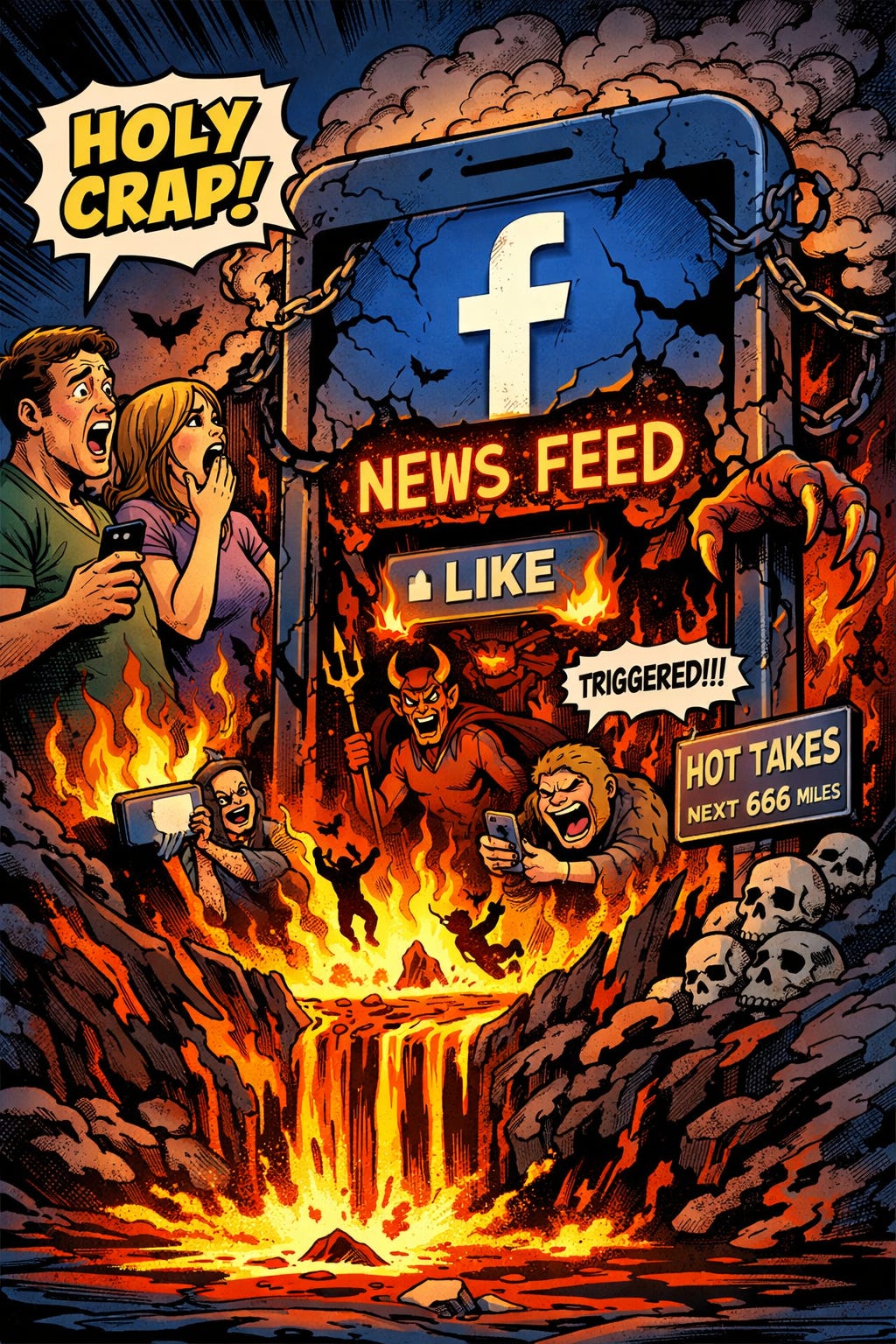
So this morning, I made the mistake of opening Facebook yesterday to check in on the “No Kings” protests.
Within about five seconds, I was staring at comment after comment of people confidently declaring, “We haven’t had kings since 1776.” As if someone had just handed them a history textbook and they felt personally obligated to share their findings with the rest of us.
Which... okay. Sure. That’s one way to engage with a metaphor. Just refuse to understand it entirely.
That was the moment I realized: Facebook has basically become a place you go to watch people misunderstand things. Loudly. Repeatedly. With complete and total confidence.
I closed the app feeling that gross mix of irritation and secondhand embarrassment, plus that creeping sense that I had just walked into a room where everyone is arguing with a metaphor and losing.
We’ve always had ridiculous people. That’s not new. But this is what the platform lifts up now. This is what it rewards.
And honestly? It got me thinking about what Facebook used to feel like. Back when logging on didn’t feel like stepping into a shouting match you never agreed to join.
There was a time when social media was actually fun. Before it was “engineered,” “optimized,” and designed to keep your nervous system in a constant low-grade panic.
Remember MySpace? Your biggest problem was whether your profile song captured your whole personality, and which friend you were about to devastate by bumping them from your Top 8. Your page was this glorious, chaotic little shrine to yourself: glitter graphics, questionable color schemes, auto-playing music that assaulted anyone who dared open your profile. It was gaudy and messy and a little unhinged, but it felt real.
Then, early Facebook showed up. Simpler. Cleaner. Just a place to keep up with people you actually knew.
And for a while, it genuinely worked. Your friends’ posts showed up in order. You saw people’s milestones. You shared photos and Superpokes (remember those??), and it felt like, I don’t know, actual connection.
Then things started shifting. Not all at once, and that’s kind of the point. If it had happened overnight, we probably would’ve noticed. We probably would’ve pushed back. But it was slow and subtle and easy to dismiss each time.
The feed stopped being chronological. No big deal, right? Just a little tweak. A “better experience.” A way to surface what matters most.
Except “what matters most” didn’t mean your friends. It meant whatever would keep you scrolling the longest.
That’s when Facebook stopped being a place and turned into a machine. One that learns what gets a reaction out of you, figures out what holds your attention, and quietly reshapes everything you see, without ever asking if that’s okay with you.
Here’s the part they leave out of the marketing copy: joy doesn’t keep you scrolling. Contentment doesn’t drive engagement.
Outrage, though? Outrage keeps your thumb moving and your brain hooked.
So little by little, your feed became this carefully curated mix of arguments, hot takes, misinformation, and posts that exist for one reason: to make you feel something strong enough to stick around. You don’t log on to catch up anymore. You log on and brace yourself. It’s basically a slot machine for your attention, and the jackpot is your emotional response.
And all that anger? It pays off for them. The more intense your reaction, the more valuable you are to the machine.
But some of us still remember what it felt like before. When it was light and kind of silly and you weren’t walking away from every scroll session feeling vaguely terrible about humanity. That version of social media is gone. Not because people stopped wanting it, but because it wasn’t profitable enough.
Connection is slow, nuanced, and hard to measure. Outrage is immediate, predictable, and easy to monetize. So the whole thing drifted toward what works. And what works is keeping us activated.
You can feel it, right? That tightness in your chest. The little spike of adrenaline. The compulsion to keep scrolling even when you stopped enjoying it ten minutes ago.
That’s not connection anymore. That’s conditioning.
And it’s not just a vague, uneasy feeling either; there’s actual legal weight behind it now. A jury recently found Meta and YouTube negligent in their platform design, ruling that the features built to maximize engagement were addictive and caused real mental health harm. The compulsive scrolling, the emotional spikes, the inability to look away even when it feels awful — that stuff was, at least partly, engineered on purpose. With your attention as the product.
It’s not just you. It never was.
So what do we actually do about it?
Realistically, most of us aren’t deleting Facebook tomorrow. Too much of our lives is still tangled up in it. But awareness changes how you move through something. And maybe that’s where it starts.
Mute the people and pages that spike your blood pressure for no good reason. Unfollow the accounts that seem to exist purely to provoke. Stop arguing with strangers who were never going to change their minds anyway. You don’t owe the algorithm your emotional energy.
Pay attention to how your body feels when you scroll. That low-level hum of stress? That’s your cue to close the app.
And when you are on there, leave a kind comment. Share something genuinely joyful. Post something that isn’t curated or trying to prove a point. Be a little cringe. That’s where the actual humanity lives.
Find the smaller spaces. Group chats. Niche communities. The corners of the internet where people are still talking to each other instead of performing at each other.
Online connection isn’t completely dead. It just got buried under a system that profits from keeping us wound up.
We can’t overhaul the whole machine overnight. But we can decide how much of ourselves we hand over to it. We can decide what we engage with and when enough is enough.
They built the machine to capture our attention. They didn’t count on us learning how to take it back.